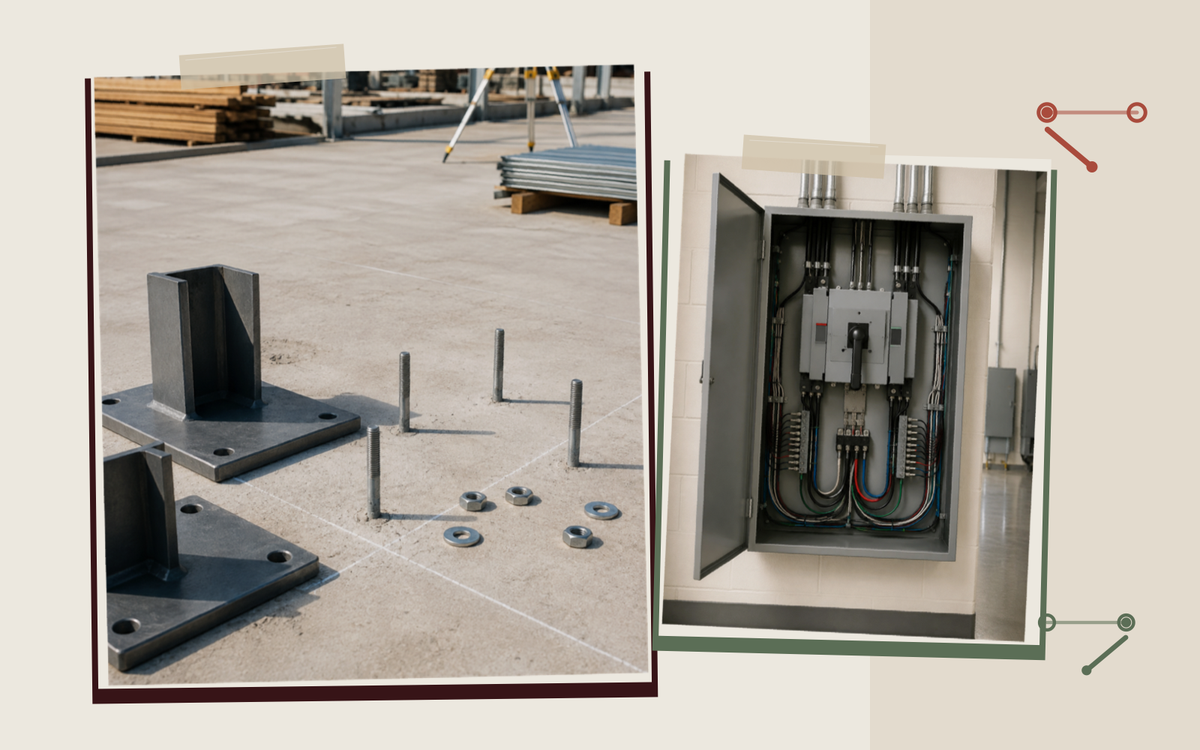
The bolts get set an inch and a half off, and in the wrong direction, which is the detail that turns an annoyance into a number.
He sets them himself, off a template he checks himself, the way a man checks something he's already sure of. The pour goes Friday morning. The steel comes the following Thursday. The base plates come off the truck, go down over the bolts, and don't go down over the bolts.
What happens next isn't dramatic. Coring, epoxy anchors, a letter from the engineer, a second trip from the inspector, three weeks the schedule didn't have. Everybody stays polite. The number sits in the background getting bigger, like a meter running in another room.
He drives in Monday with the sentence ready, I know what this cost and I'm not going to argue, fully intending to be fired with some dignity.
He is told to go finish the punch list on the other job.
Anyone who has worked a trade has heard a version of this, details swapped. The number changes. The eleven days do not.
The switch
In any building that has to keep running, there's a switch sitting between the utility and the emergency panel. The power drops, the switch throws, and the load lands somewhere else. Inside, one fluorescent tube stutters. The people at the desks keep typing. Nothing in the room tells them something outside is now burning fuel so the room can stay ordinary.
That's roughly what happens to him, and he doesn't hear it happen.
The coring crew gets paid out of a line meant for something else. A deposit goes in late and the next job goes to an outfit that got its deposit in on time. Nothing's announced. He works all of August under lights he assumes come from the street.
It is not done gracefully
The owner doesn't speak to him for eleven days. Not cold, exactly. He nods, he hands over a print, but he routes around him the way you route around a hole in a floor. A man who's just eaten a five-figure mistake is entitled to a bad two weeks. The man on the other end of it reads the silence as contempt and drafts his resignation twice.
Then in December, at the thing they do at the Italian place, the story gets told to the whole table for the laugh, with his name in it. He laughs too. It sits in him for nine years.
And nobody ever says why. Not everybody gets one, not you're worth more than a slab, not anything. He's left to supply the reason himself, and the one he supplies, that he's being kept out of pity and will be let go quietly after the season, is worse than the true one and lasts a great deal longer.
He tries to give it back
He offers to have it taken out of his checks. The offer gets refused flatly, in a tone closer to sit down than to generosity, and he resents it for a while, which is the part men leave out when they tell this kind of story.
So he does what's available: Saturdays, for about a year, against a ledger nobody's keeping.
And for a decade he tells it as a story about his own screwup: the template, the tolerance, the six-day-old pour that couldn't have cared less about anyone's opinion. That version belongs to him. It has a lesson in it, he's the one who learned it, and it never once requires him to say the words somebody covered for me.
It may be arithmetic
Here's the part that doesn't resolve. It's entirely possible he's kept because keeping him is cheaper. He's just been through the most expensive education in his trade, at no cost to whoever hires him next, and firing him would hand that away. Loyalty and a spreadsheet point the same direction more often than either party cares to look at.
He doesn't know the split, and never will. The load moves either way, and the lights he works under in August come from somewhere.
Most panels have nothing behind them
Plenty of men get the other version, and it should be said here rather than left for someone to notice on his own.
The number gets read back to you in a room with somebody from HR present, you're out by Friday, and the arithmetic that didn't save you was the same arithmetic. Or nothing gets covered at all, ever, for anyone, and a man does his own coring at night for eleven years and calls it self-reliance, because there's no other word handy and the alternative is looking straight at how alone he's been.
Nothing here says the switch always throws. Most panels have nothing behind them, which is the ordinary condition and not the exception. One man getting carried isn't a claim about how often men get carried.
He finds out sideways
He finds out years later, and sideways. At a retirement lunch, from the daughter who did the books that summer between semesters and remembers it the way you remember a bad month at nineteen. Tear-out, coring, the engineer, the inspector, and a five-figure number he'll repeat to himself on the drive home.
Her father skipped his own draw in August, and again in September, and told her not to leave the paperwork anywhere her mother would find it.
Then the plates come out, and somebody at the end of the table starts arguing about the parking, and that's the whole conversation.